Epoxy Pool Surrounds in Queensland: The Homeowner's Guide
If you've got a pool in Queensland, the surface around it works harder than almost any other floor in your home. It gets hammered by UV, soaked daily, walked on barefoot by kids and adults, and splashed with chlorinated water all summer. Most standard finishes — bare concrete, old pavers, ceramic tiles — don't hold up well under those conditions, or they become genuinely dangerous when wet.
Epoxy pool surrounds are gaining serious traction with Queensland homeowners, and for good reason. A properly installed epoxy system with the right topcoat and anti-slip aggregate gives you a surface that's slip-rated for wet barefoot use, UV-stable, chemical-resistant, and easy to clean. But — and this matters — not all epoxy is suitable for outdoor pool use. The system has to be specified correctly for outdoor Queensland conditions, or it will yellow, peel, or fail faster than you'd expect.
TL;DR
Bare concrete and smooth tiles are genuine slip hazards around pools. For wet barefoot areas you need a P4 or P5 slip rating per AS 4586. Standard indoor epoxy will yellow outdoors — you need a UV-stable aliphatic polyurethane or polyaspartic topcoat. Flake systems are the most popular choice because the broadcast flake naturally adds texture and slip resistance. Proper diamond grinding prep is non-negotiable. Most residential pool surrounds are completed in a day or two, with light foot traffic possible within 24 hours.
Why Your Pool Surround Matters More Than You Think
Queensland homeowners spend a lot on their pools — filtration, chlorinator, landscaping — and comparatively little thought on the surface they're standing on every time they get in or out. That surface matters for three reasons: safety, durability, and maintenance. Wet, smooth concrete or glazed tiles are slippery, full stop. Safe Work Australia consistently identifies slips, trips and falls as among the most common causes of serious injury in the home. Queensland's UV index regularly hits 11+ in summer, concrete can reach 60–70°C in direct sun, and chlorine splash and thermal cycling punish most coatings. Unsealed concrete also stains, grows algae, and becomes progressively harder to clean.
What Slip Resistance Actually Means
The Australian Standard AS 4586 classifies wet barefoot surfaces using a P rating from P1 to P5. P3 is acceptable for low-risk wet barefoot areas, P4 is recommended for pool surrounds, and P5 is the highest resistance. For a pool surround you want at minimum P4. Epoxy with the right aggregate broadcast into the topcoat achieves P4 or P5 easily — but a contractor who can't specify this in writing probably isn't the right person for the job. Ask directly: 'What slip rating will this system achieve, and how is it tested?'
Why Most Standard Epoxy Isn't Suitable for Queensland Pools
The same epoxy system that works beautifully on an indoor garage floor will likely fail within 12–18 months on an outdoor pool surround. Standard indoor epoxy is aromatic, meaning it reacts to UV light — it yellows, chalks, and loses gloss within months, eventually becoming brittle. The fix is a UV-stable topcoat: either an aliphatic polyurethane (flexible, colour-stable, handles thermal cycling) or a polyaspartic (newer, faster cure, excellent UV stability and high-heat performance). Ask your installer: 'Is this system rated for continuous outdoor UV exposure? What's the topcoat chemistry?'
The Most Popular Finish: Decorative Flake Systems
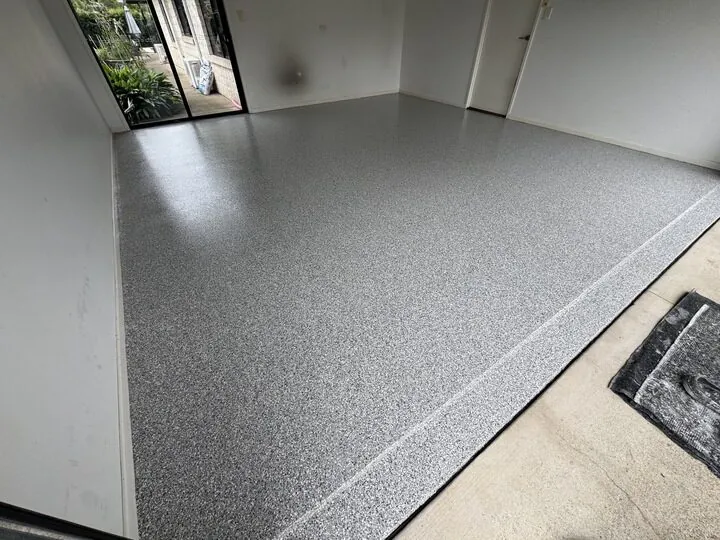
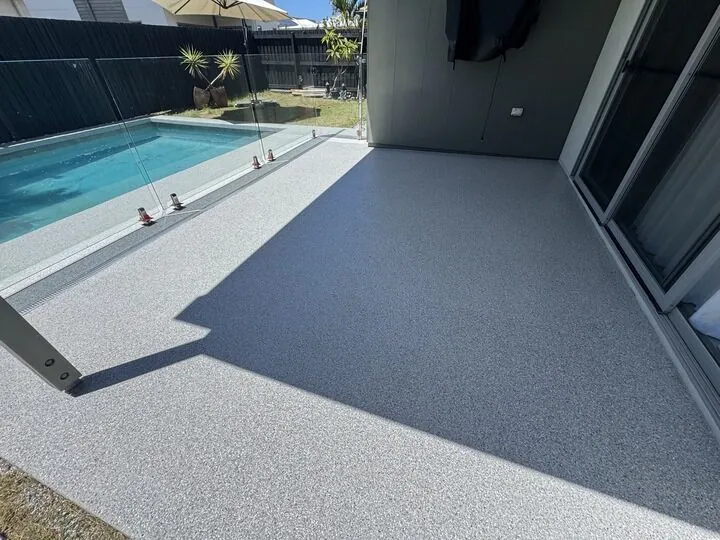
If you've seen a pool surround done in epoxy, odds are it was a decorative flake system. Coloured vinyl flakes are broadcast onto the wet epoxy base coat before a UV-stable clear topcoat is applied. The flake adds three things: natural texture for slip resistance without feeling harsh underfoot, dozens of colour combinations to match your home's exterior, and hiding power for minor imperfections and hairline cracks in the underlying concrete. For Gold Coast and Sunshine Coast homes where outdoor aesthetic matters, flake systems look great and hold up to pool use.
Heat: The Factor People Forget
Dark surfaces absorb heat. A dark-coloured epoxy surface in direct Queensland summer sun can get genuinely painful underfoot for kids. Lighter colours reflect more UV and stay cooler. Mid-tones with a textured surface (a light to mid grey flake blend) are a practical middle ground — they don't show dirt obviously, and don't absorb heat the way charcoal does. High-gloss finishes generally aren't recommended outdoors: they show footprints and water marks constantly, and don't help with slip resistance. A good installer will discuss colour in the context of your pool orientation and afternoon sun exposure.
Comparing Epoxy to Other Options
Concrete pavers shift, crack and develop trip hazards over 5–10 years; joints fill with algae and pavers absorb pool chemicals. Smooth ceramic/porcelain tiles are a slip risk when wet, and grout joints stain and require re-grouting. Rubber matting looks budget, degrades in UV in 2–4 years and harbours bacteria. Exposed aggregate concrete looks great and has natural slip resistance but costs more, is harsh on bare feet, and hairline-cracks over time. Epoxy suits homeowners who want a clean modern look, easy maintenance, and a guaranteed slip rating — not the cheapest upfront, but lower lifetime cost than pavers or tiles, provided it's specified correctly for outdoor UV.
What the Installation Actually Involves
Step 1 — Surface preparation: the concrete is diamond-ground to open the surface profile and remove sunscreen, pool chemicals and algae contamination. No grinding, no bond. Step 2 — Crack and joint treatment: cracks are assessed and treated; control joints are respected, never bridged. Step 3 — Primer: a penetrating primer matched to the substrate's moisture conditions. Step 4 — Base coat and flake broadcast: epoxy base coat applied, flake broadcast into the wet coat, excess removed and surface lightly abraded. Step 5 — UV-stable topcoat: aliphatic polyurethane or polyaspartic with anti-slip aggregate, two coats standard for outdoor high-wear. Most 30–60 m² residential pool surrounds are completed in one to two days. Light foot traffic within 24 hours; full cure for pool use 5–7 days.
Maintenance: What to Expect Long-Term
Daily/weekly: hose down. The smooth surface doesn't trap algae the way pavers or rough concrete do. Monthly: a pH-neutral cleaner with a soft mop. Avoid acidic cleaners — pool acid should never be used directly on the surface. Periodic: a UV-stable topcoat can be refreshed every 8–12 years as a maintenance coat, a fraction of the cost of full replacement. Compared to re-sanding pavers every 2–3 years or re-grouting tiles, the maintenance story is straightforward.
Frequently Asked Questions
Is epoxy slippery around a pool? A properly specified system is not — it's typically safer than what it replaces, provided it's designed for wet barefoot use with anti-slip aggregate. Can epoxy handle chlorine? Yes, with a UV-stable polyurethane or polyaspartic topcoat. Avoid direct pool acid contact. Will it get too hot? Depends on colour — light to mid tones stay significantly cooler. How long does it last? With correct installation, 15–20 years before significant maintenance; topcoats can be refreshed without full replacement. Can it go over pavers or tiles? Generally no — best results come from working directly with the concrete substrate. Does the pool need to be empty? No, work is on the surrounding concrete; minimise splashing for 24–48 hours while the topcoat cures. Cost? For a 30–60 m² residential pool surround, a quality UV-stable system with anti-slip aggregate typically runs $60–$120 per m² installed.
QFS — Queensland Flooring Systems
QBCC 15592571. 10-year materials warranty + lifetime workmanship warranty. Servicing Sunshine Coast, Brisbane, Gold Coast, Ipswich, Toowoomba and South East Queensland. Free measure and itemised quote inside one business day — call 0440 131 881 or request a quote online.
Have a project in mind?
Free measure & itemised quote inside one business day. No pressure, no upsell — just trade-honest advice.
Get a quote